Ketamine-assisted therapy (or KAP, short for Ketamine-Assisted Psychotherapy) is a treatment in which a professional administers ketamine in a controlled clinical setting and combines it with psychotherapeutic support. It is used, above all, for treatment-resistant depression and other mood disorders when conventional treatments have not worked. In this complete guide we explain what it is, how it works, what it is used for, what a session looks like and what the scientific evidence says.
What is ketamine-assisted therapy (KAP)?
KAP is not simply about administering a drug: it integrates two components that work synergistically. On one hand, ketamine, a molecule with anaesthetic and dissociative properties that, at low, supervised doses, induces an altered state of consciousness. On the other, psychotherapy, which takes advantage of the window of greater psychological flexibility that ketamine opens to work on emotions, memories and patterns that are difficult to address in an ordinary state.
Unlike recreational use, KAP is always carried out with medical indication, supervision and controlled doses by healthcare staff, within a structured therapeutic framework of three phases: preparation, session and integration.
How does ketamine work in the brain?

Ketamine acts mainly on the glutamate system, the most abundant excitatory neurotransmitter in the brain, by blocking NMDA receptors. This triggers a cascade of effects that research associates with increased neuroplasticity: the brain’s ability to create and reorganise neural connections. Increases in factors such as BDNF and the formation of new synapses within hours have been described, which could explain why its antidepressant effect appears much faster than that of classic antidepressants.
That same mechanism opens a “therapeutic window” of several days during which a person tends to be more receptive to change. This is why psychological support is so important: it helps consolidate what happens during and after the experience.
What is it used for?
The most studied uses of ketamine therapy include:
- Treatment-resistant depression, when other antidepressants have not worked.
- Suicidal ideation, owing to its rapid action in crisis situations (always in a clinical context).
- Anxiety disorders and post-traumatic stress disorder (PTSD).
- Some forms of chronic pain.
Esketamine (Spravato), a nasal-spray variant, is approved by the FDA and the EMA for treatment-resistant depression, which has consolidated clinical interest in these approaches.
What a ketamine therapy session is like
Although each protocol varies, a KAP session usually follows these phases:
1. Preparation
The clinical history is assessed, goals are set and care is taken with set (mindset) and setting (environment). Good preparation is key to a safe and meaningful experience.
2. The session
In a calm, supervised space, ketamine is administered (intramuscularly, intravenously, sublingually or nasally depending on the protocol). The person usually rests with an eye mask and music while the team monitors vital signs and provides support.
3. Integration
In the following sessions, the meaning of the experience and how to translate it into concrete changes in daily life are explored. Integration is what turns a one-off experience into a lasting benefit.
Safety, side effects and contraindications
Administered by professionals at controlled doses, ketamine has a well-known safety profile. Even so, it can cause transient effects such as dissociation, dizziness, nausea or increased blood pressure. There are contraindications (for example, certain cardiovascular or psychiatric conditions) that must be assessed before treatment. This is why it should never be done independently or outside a clinical setting.
What does the scientific evidence say?
Research on ketamine and mental health has grown enormously over the last decade. Studies support its rapid efficacy in treatment-resistant depression, and models that combine the drug with psychotherapy (KAP) point to more sustained benefits than the drug alone. It remains an evolving field: more long-term trials are needed, and practice must always be based on the best available evidence and on each country’s regulations.
Training for professionals
The rise of these therapies has driven demand for trained professionals. If you are a psychologist, psychiatrist or therapist and want to specialise, you can see our ketamine-assisted therapy training course and the rest of our training for therapists at Fuertedélica.
Ketamine and psychedelics at Fuertedélica
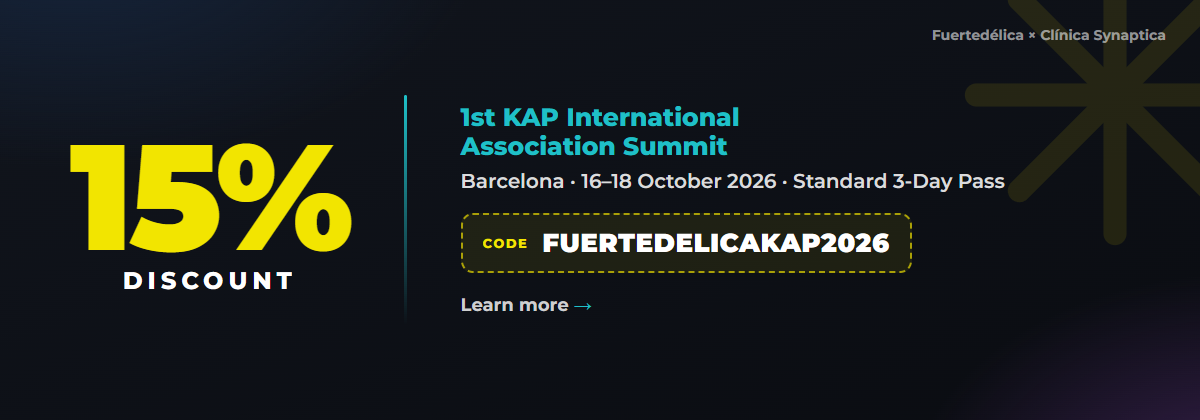
At Fuertedélica, the international conference on psychedelics and mental health, we dedicate space to the science and practice of KAP. This guide stems from our collaboration with Clínica Synaptica, organiser of the 1st KAP International Association Summit (Barcelona, 16–18 Oct 2026), for which the Fuertedélica community gets a 15% discount on the Standard 3-Day Pass with the code FUERTEDELICAKAP2026.
Frequently asked questions
Is ketamine therapy legal?
Ketamine is a hospital-use medicine; its therapeutic use depends on each country’s regulations and must be carried out by authorised healthcare staff.
How quickly does it take effect?
Unlike classic antidepressants (weeks), many patients notice mood changes within hours or a few days, although sustained benefit depends on the full therapeutic process.
Is it the same as using ketamine on my own?
No. KAP involves medical indication, controlled doses, supervision and psychotherapeutic work of preparation and integration. Independent use carries serious risks.
This article is for informational purposes and does not constitute medical advice. If you are considering a mental health treatment, consult a qualified healthcare professional.
