
Psilocybin, one of the main active compounds in psilocybin mushrooms, is showing promising results in the treatment of mental disorders such as treatment-resistant depression. In this context, the Spanish company Ethno Phyto Tech, based in Córdoba, aims to become a global benchmark in the production of naturally sourced psilocybin.
Natural vs. Synthetic Psilocybin Production
Unlike other companies in the sector that focus on synthetic psilocybin, EthnoPhytoTech centers its model on the direct extraction of the compound from mushrooms. The company currently works with 60 strains belonging to five different species from the Psilocybe and Panaeolus families.
This approach not only seeks production efficiency but also incorporates a strong environmental conservation component. Many psilocybin mushroom species are threatened by climate change. The recovery and preservation of their genomes functions as a biological “backup,” contributing to biodiversity protection.
As Xaquín Acosta, COO of the company, explains in conversation with Fuertedélica, genetic preservation is an essential part of the project.
Psilocybe gallaeciae: The Endangered Galician Magic Mushroom
One of the most notable species for the company is Psilocybe gallaeciae, native to Galicia.
“Personally, one of the species I like most is Psilocybe gallaeciae, perhaps because it’s from my homeland, Galicia. I remember as a young man finding entire meadows covered with this magnificent mushroom. However, with each passing year, fewer and fewer are being found.
The world changes, climate zones change as well—just think of those cave paintings found in the Tassili desert, from a time when it was a fertile landscape where these types of fungi grew, and now it is a desert. It is likely that something similar could eventually happen in the Iberian Peninsula.”
P. gallaeciae also stands out for its high psilocybin content, which can reach 2.5% of the mushroom’s weight—double the usual average of 1%.
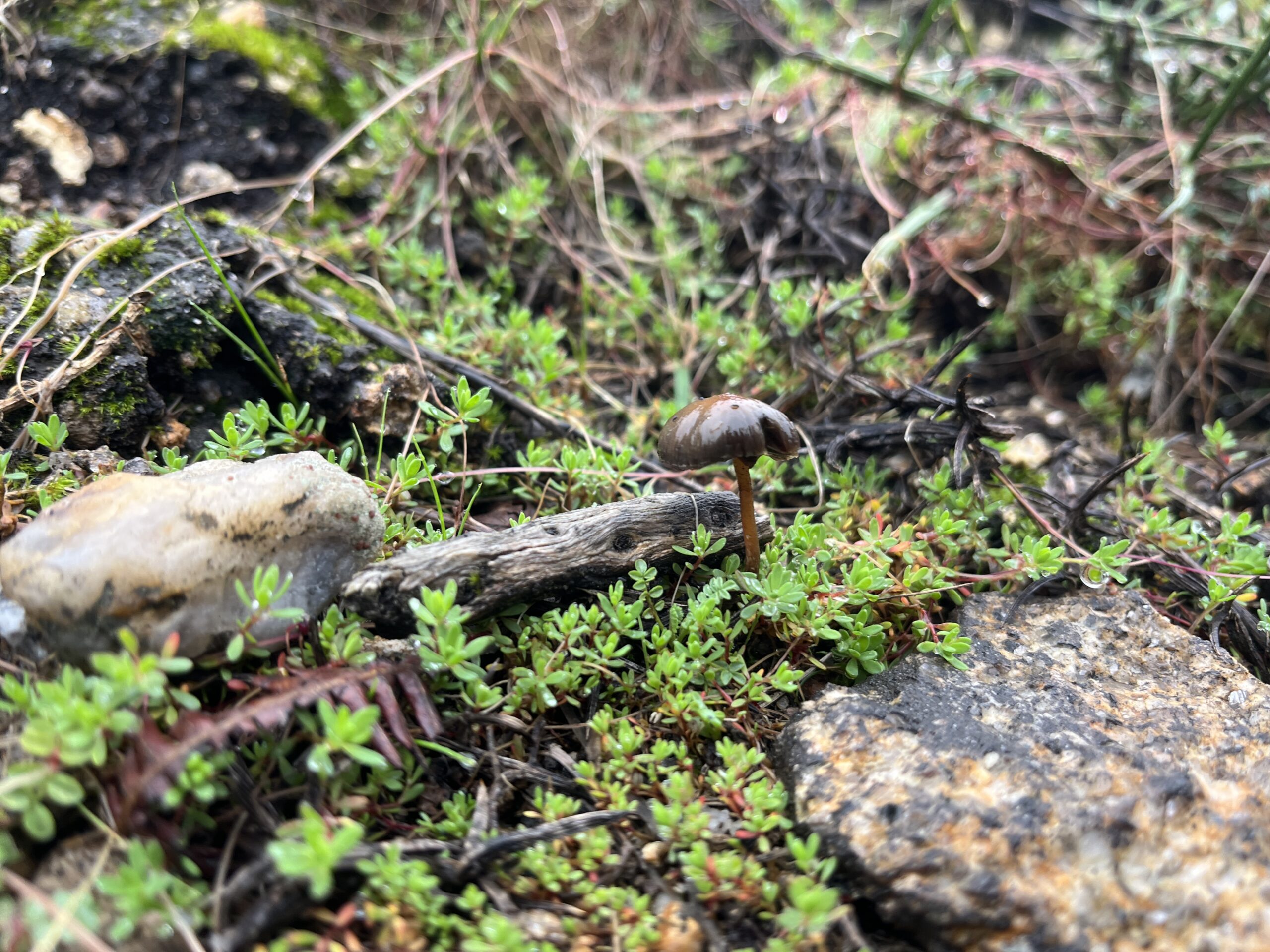
Specimen of P. gallaeciae in its natural environment.
Acosta, an agricultural engineer with a degree in Environmental Sciences, has extensive experience in the field of medical cannabis, both in activism and scientific research. In addition to his work at EthnoPhytoTech, he serves as a court expert witness in cannabis-related cases and advises companies in the sector.
An Innovative Method to Produce Psilocybin
Psilocybin is the most abundant and well-known alkaloid in psilocybin mushrooms, along with other compounds such as psilocin and baeocystin.
Together with Dr. Xavi Nadal, CEO and founder of EthnoPhytoTech, the company has developed an innovative mycelium production method that could eliminate the need to cultivate the fruiting body (the mushroom itself), significantly reducing production costs and increasing industrial scalability.
This advancement positions the company at the forefront of biotechnology applied to psychedelics.
Psilocybin and Mental Health: A Growing Therapeutic Alternative
Over the past decade, the prevalence of depression in developed societies has increased by 30%. In Europe alone, treatment-resistant depression generates an estimated economic burden of between €28 billion and €53 billion annually. Why? A large percentage of people suffering from depression report no improvement with antidepressant medications.
A significant portion of patients does not respond adequately to conventional antidepressants. Faced with this reality, the scientific community is reviving interest in psychedelic-assisted therapy, a discipline that flourished in the 1950s and 60s before being halted by international drug control policies.
In Acosta’s words:
“In cases of treatment-resistant depression, we’re talking about patients with histories spanning 5, 10, or even 20 years. With psilocybin treatment, many experience significant improvement. The positive response rate can reach 70% of cases. Of that percentage, between 30% and 50% maintain the improvement over time. However, it is not a panacea, and relapses do occur.”
Legal Framework of Psilocybin in Spain and Europe
Currently, psilocybin is included in the UN List of Prohibited Substances. However, psychedelic-assisted therapy already has specific regulatory frameworks in countries such as Germany, Switzerland, the Czech Republic, Australia, Canada, and several U.S. states.
In Spain, the Narcotics Law allows the production of controlled substances as long as they are intended for medical or scientific purposes.
“The development of our project depends largely on the regulatory framework—not only in Spain or Europe, but worldwide,” Acosta notes.
Business Plan: Production, Investment, and Market Forecasts
EthnoPhytoTech plans to develop and optimize its production, extraction, and purification methods over the next two years. To this end, it has opened a first investment round of €600,000, which could be doubled with public funding support.
After this initial phase, in 2028, the company plans to build a facility with a maximum production capacity of 5 kilograms per year of purified psilocybin—an amount sufficient to treat approximately 83,000 patients with two annual doses, or 166,000 patients with a single dose.
This second round contemplates an investment of €3.5 million. According to the business plan, both investments could be recovered starting in 2031, when profits would begin to be generated, always subject to regulatory developments and demand consolidation.
Market prospects are favorable. The global psilocybin-assisted therapy sector is estimated to grow from €1.5 billion in 2024 to €6.8 billion by 2030, with a compound annual growth rate (CAGR) of 18.5%.
For more information about Ethno Phyto Tech, you can visit their website at Ethnophytotech.es.

Journalist, director of the documentary series Voices of Ayahuasca, member of the Plantaforma for the Defense of Ayahuasca (www.plantaforma.org), co-organizer of Fuertedélica, and black belt in karaoke.