Ketamine for depression is one of the most talked-about advances in mental health over the past decade. At low doses and under medical supervision, it has been shown to reduce depressive symptoms with a speed that classic antidepressants cannot match, especially in treatment-resistant depression. In this article we review what the scientific evidence says, who it is indicated for, how quickly it works and what its limitations are.
Why is ketamine different from a classic antidepressant?
Common antidepressants (SSRIs, SNRIs) act on serotonin or noradrenaline and usually take several weeks to work. Ketamine works through a different route: it acts on glutamate by blocking NMDA receptors, which is associated with increased neuroplasticity within hours. If you want to understand the mechanism in detail, we explain it in our complete guide to ketamine-assisted therapy (KAP).
What does the scientific evidence say?
Research in recent years supports several key points:
- Treatment-resistant depression: multiple clinical trials show rapid symptom reductions in people who have not responded to two or more antidepressants.
- Esketamine (Spravato): a nasal-spray form of ketamine, is approved by the FDA and the EMA for treatment-resistant depression in combination with an oral antidepressant — significant regulatory backing.
- Speed: unlike the weeks that classic antidepressants take, many patients notice improvement within hours or a few days.
Even so, it is an evolving field: the duration of the effect is variable and usually requires a maintenance plan, and more long-term studies are needed. The evidence is stronger for treatment-resistant depression than as a first-line treatment.
Ketamine and suicidal ideation
One of the most promising areas is the rapid reduction of suicidal ideation. Because of its almost immediate action, ketamine has been studied as a tool in crisis situations — always within a clinical context and as part of a broader therapeutic plan, never in isolation.
Ketamine alone or with psychotherapy (KAP)?
Ketamine can be given as a pharmacological treatment, but there is growing interest in combining it with psychological support: ketamine-assisted therapy (KAP). The idea is to use the “neuroplasticity window” to work in therapy on the patterns that sustain depression, aiming for more lasting benefits than the drug alone. We develop this in the KAP guide.
Limitations and precautions
Ketamine is not a magic solution nor suitable for everyone. It can cause transient effects (dissociation, dizziness, raised blood pressure) and has contraindications that must be assessed. Its use must always be indicated and supervised by healthcare staff; recreational or independent use carries serious risks and is not equivalent to treatment.
Training for professionals
If you are a mental health professional and want to train in this approach, see our ketamine-assisted therapy (KAP) training course and Fuertedélica’s training for therapists.
Ketamine at Fuertedélica
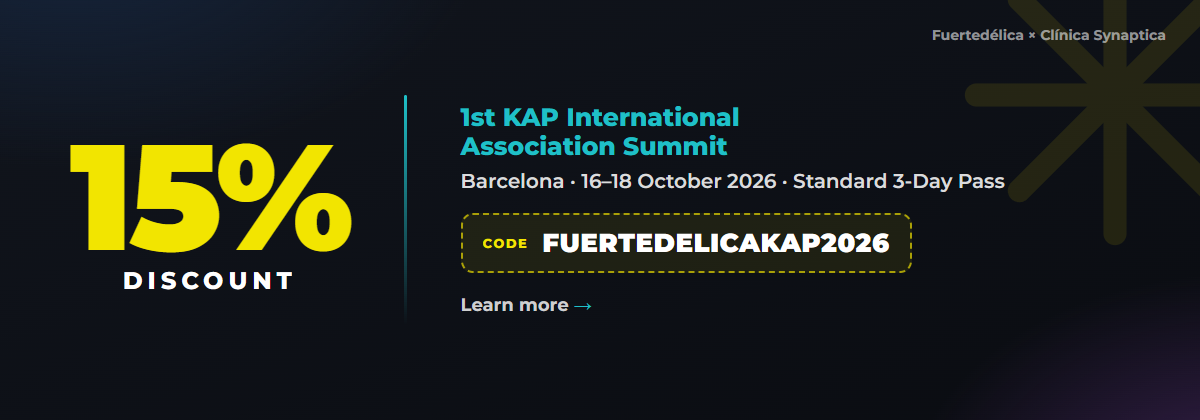
At Fuertedélica we dedicate space to the science of ketamine and psychedelics in mental health, in collaboration with Clínica Synaptica, organiser of the 1st KAP International Association Summit (Barcelona, 16–18 Oct 2026), with a 15% discount for the community using the code FUERTEDELICAKAP2026.
Frequently asked questions
Does ketamine cure depression?
We don’t talk about a “cure”. Ketamine can reduce symptoms quickly, especially in treatment-resistant depression, but sustained benefit depends on a full therapeutic plan and, often, maintenance.
How quickly does it work?
Many patients notice improvement within hours or a few days, versus the weeks classic antidepressants take.
Is it safe?
Administered by professionals at controlled doses it has a known safety profile, but there are contraindications and transient side effects. It should never be used outside a clinical setting.
This article is for informational purposes and does not constitute medical advice. If you are considering treatment for depression, consult a qualified healthcare professional.
