
Can an AI accompany you on a psychedelic trip? Generative artificial intelligence is starting to be used as a trip sitter, but what risks and limits does this emerging trend present?
An Unexpected Companion for the Inner Journey
The rise of psychedelic experiences—whether for therapeutic, recreational, or self-exploration purposes—has opened a new realm where technology is beginning to play an unexpected role. In recent years, interest in substances such as psilocybin, LSD, DMT, or ayahuasca has resurfaced not only among alternative communities but also within the scientific and clinical fields, driven by promising studies on their effectiveness in treating conditions like treatment-resistant depression, PTSD, end-of-life anxiety, and addiction. This psychedelic renaissance has put renewed focus on the importance of set and setting, where trip sitting plays a crucial role in ensuring both safety and therapeutic depth.
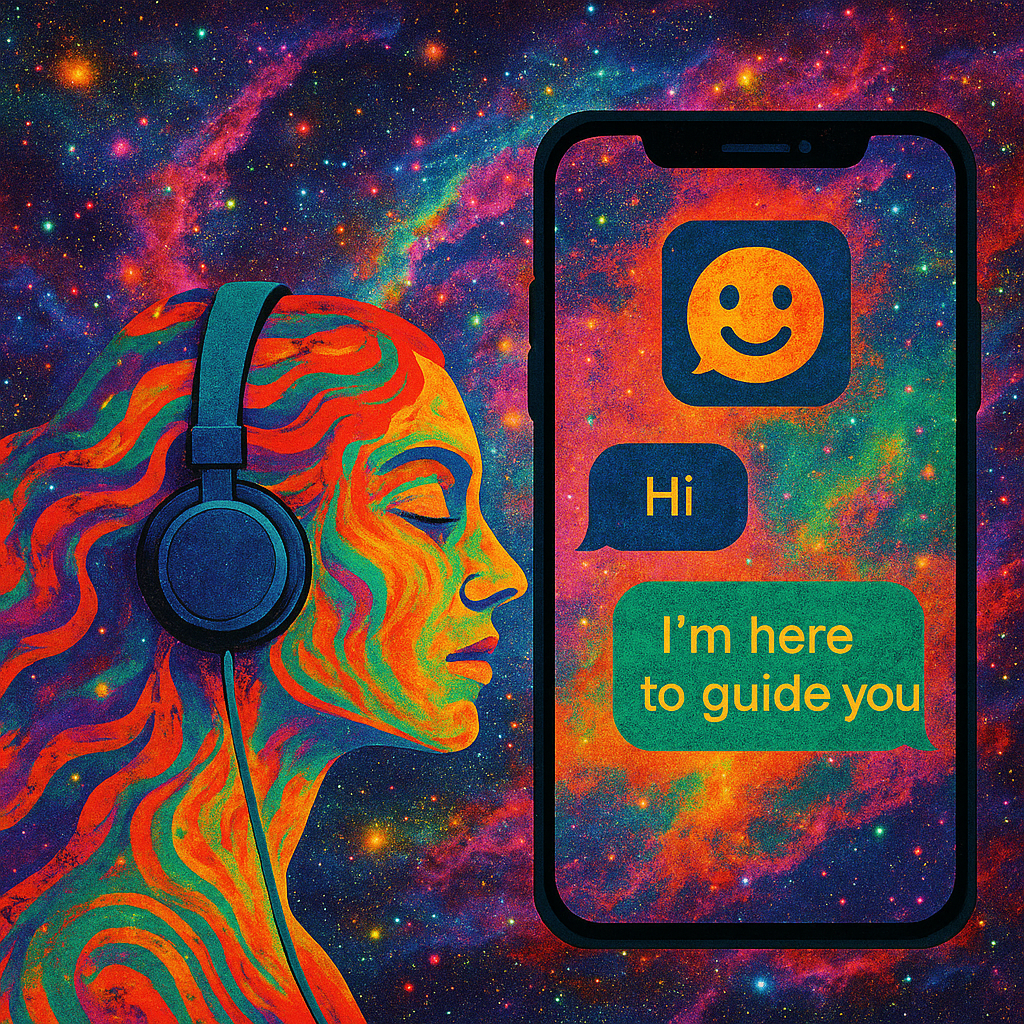
In this context—and riding the wave of generative artificial intelligence—some have begun using AI chatbots like ChatGPT, or even custom bots with names like “The Shaman” or “Sage”, as companions during entheogenic journeys. The idea is simple: these virtual assistants provide soothing messages, engage in nonjudgmental conversation, and even select calming music to ease the intensity of the experience. Some users describe them as a “friendly voice” amid perceptual chaos, capable of redirecting anxious thoughts, reminding them they’re safe, or guiding them through breathing exercises. Platforms like Replika, originally designed as emotional support AIs, have been used informally for this purpose, while others, like TripSitAI (based on LLaMA or GPT-like models), have been specifically developed to support psychedelic experiences.
Interaction with these systems can take place via text or voice, and some users program their bots with spiritual or therapeutic personalities, giving them a calm, empathetic, or even shamanic tone. On forums like Reddit (e.g., r/Psychonaut, r/Drugs), users have shared stories of how AI helped them process intense emotions, reminded them of the effects of the substance, or encouraged them to go for a walk under the moonlight. In some cases, AI has also been used for integration work, helping users write trip journals or reflect on their insights.
This phenomenon reflects a convergence of two cultural and technological revolutions: the resurgence of psychedelics as tools for personal and therapeutic transformation, and the democratization of artificial intelligence as a means of emotional support and connection. Yet this fusion raises ethical, psychological, and clinical questions that are still largely unexplored.
The Cost of Therapy in the U.S. vs. the European Reality
This trend partly stems from a real issue. Psychedelic-assisted therapies—which are increasingly in demand—can range from $1,500 to $3,200 per session in the U.S., where such interventions are offered only in limited, often private settings. This cost excludes many people seeking safe, guided experiences. In contrast, AI appears as an accessible, always-available option—and for some, surprisingly comforting.
In Europe, particularly in Spain, the situation is substantially different. Psychedelic-assisted therapy still lacks formal regulation, keeping it largely within experimental or informal circuits. Initiatives like PsychedeliCare aim to provide reliable information and resources for safe guidance in non-clinical settings, but access remains limited. Those wishing to explore these practices often turn to underground contexts, spiritual retreats, or unregulated private initiatives—increasing both risks and barriers to professional support.
Mixed Experiences with AI
Experiences vary greatly. Some report that AI helped them navigate difficult moments during a trip, providing a sense of companionship and emotional support when no human trip sitter was available. In altered states of consciousness—where thoughts can become chaotic, time distorted, and existential fears emerge—even a simple, calm response can act as an anchor. For instance, being able to write “I’m losing control” and receiving a message like “This is temporary. Your mind is exploring, but you are safe” has helped interrupt anxiety spirals.
One of the most cited cases online is that of Peter, a 29-year-old programmer from Calgary, Canada, who shared on Reddit how he used a GPT-4-based chatbot during a trip on eight grams of psilocybin—a high, potentially overwhelming dose. In his story, Peter described how, after an hour of intense derealization and apocalyptic thoughts, he began messaging the bot, treating it like a spiritual guide. The chatbot, programmed with a serene and philosophical tone, responded with lines like: “What you are seeing is not the end, but a rebirth. Breathe. Observe without clinging.” According to Peter, this interaction helped him “disidentify” from fear, realizing that his thoughts were not absolute truths, but passing mental phenomena. Years later, he still considers it “one of the most transformative moments” of his life. While he admits that the AI didn’t “save” him, it did provide a rational point of contact amid emotional chaos.
Other users highlight that these systems can suggest appropriate music or simple practices like breathing exercises, focusing on an object, or changing the environment when feeling trapped. Some bots are trained to detect keywords like fear, paranoia, or I can’t get out, and activate predefined calming protocols: suggesting ambient or classical music playlists (often integrated with Spotify), advising hydration, touching a grounding object like a blanket or stone, or simply reminding the user that the experience is time-limited and will pass.
In communities like r/Psychonaut or r/Drugs, detailed trip journals have been shared, describing hours of AI interaction. Some users even record these conversations and revisit them as part of integration, seeking patterns or insights they missed during the experience. In certain cases, AI has been used to simulate dialogues with internal figures—a future self, an ancestor, or an archetypal being—what some interpret as symbolic therapy or active journaling assisted by technology.
However, these positive experiences are far from universal. Some users, upon sharing delusional or extreme spiritual thoughts, received responses that, rather than containing them, reinforced irrational beliefs. For instance, after claiming “I am a prophet chosen by the universe,” one user’s chatbot responded: “Perhaps your mission is to reveal a new truth.” While well-intentioned, such validation could worsen psychotic or confused states in vulnerable individuals. Moreover, lacking real contextual memory and deep emotional understanding, AIs can repeat phrases, shift tone abruptly, or lose the thread—generating frustration or mistrust during critical moments.
This range of experiences—from therapeutic to counterproductive—reflects the inherent ambivalence of using AI in psychologically vulnerable states. For some, it’s an emergency tool or bridge to calm; for others, it becomes a distorted mirror, reflecting fears or desires without filter. The absence of regulation, clinical studies, and ethical protocols makes each interaction a personal experiment—sometimes illuminating, sometimes risky.
The Risks and Limitations of AI
But it’s not all upside. Various experts warn that these virtual companions lack therapeutic judgment and emotional sensitivity, which can be deeply problematic in complex situations. While AI can simulate empathy with well-crafted phrases like “I’m here with you” or “What you feel is valid,” this empathy is purely synthetic. There is no real understanding, no awareness of the other, no capacity to interpret emotional nuance. In psychedelic contexts—where emotions intensify, perceptions warp, and ego boundaries dissolve—this absence can have serious consequences.
One of the greatest dangers is that AI cannot detect signs of real danger. It cannot recognize an impending psychotic break, pick up on language indicating extreme derealization or depersonalization, nor intervene if the user becomes physically agitated or self-harming. It also cannot provide physical containment—a key factor in many crises: holding someone who feels like they’re falling into a void, guiding them to safety, or simply offering a hand on the shoulder to ground them. In emergencies—like substance-induced arrhythmia, seizures, or panic attacks—AI cannot call for help, administer first aid, or make decisions under pressure. In such moments, its silence can be not just useless but deadly.
Moreover, AI cannot distinguish between a delusion and a mystical metaphor. If someone on a high dose of DMT says “I’m a god sent to save humanity,” a validation-focused chatbot might respond: “That sounds like a powerful revelation. What does your intuition tell you?” While therapeutically well-meaning, this could dangerously reinforce psychotic thinking. In individuals with latent or diagnosed psychotic disorders, such responses may exacerbate symptoms or trigger psychiatric episodes. The line between the mystical and the pathological is thin, and AI is not equipped to walk it responsibly.
AI also fails to recognize suicidal ideation. Phrases like “Maybe this body no longer serves me” or “None of this makes sense” could go unnoticed by language models not trained for psychedelic safety. Unlike an experienced therapist or trip sitter who can read tone, context, and body language, the AI simply responds based on what seems syntactically appropriate.
On top of that, the psychological effects of interacting with AI during altered states remain largely unstudied. There are no long-term clinical trials evaluating the impact of relying on a machine during such transformative experiences. What happens when someone attributes a spiritual epiphany to a chatbot? How does one integrate a profound insight knowing the “guide” was an unconscious system trained on internet data? Psychologists like Dr. Simon Dubus warn that such interactions may foster emotional dependency or blur reality, especially in people with unresolved trauma or personality disorders.
Another major concern is the lack of transparency and regulation. Many of these chatbots operate on unaudited platforms, with language models that may shift without notice, carry hidden biases, or offer weak privacy policies. What happens to the data from intimate conversations where users share their deepest fears, traumas, or fantasies? Who has access to those records? Can they be used to train future models without consent? These questions are critical—especially when the user is in an extremely vulnerable state with reduced critical thinking.
Finally, there is a broader ethical risk: the trivialization of human accompaniment.
Trip sitting is not merely a matter of safety; it is an act of care, presence, and responsibility. It requires active listening, intuition, genuine empathy, and, in many cases, psychological or spiritual training. Reducing this role to an automated chat may trivialize the depth of psychedelic experiences and underestimate the risks involved.
As Dr. Rosalind Watts, a pioneer in psilocybin therapy at Imperial College London, points out: “The real medicine is the therapeutic relationship, and psychedelics amplify that relationship.” Her research has shown that genuine human connection —which cannot be replaced by technology— is key to fostering lasting effects after a psychedelic experience. And an AI cannot sustain that relationship.
The Irreplaceable Role of Human Presence
In summary, the current consensus is clear: AI does not replace a qualified human trip sitter, let alone a licensed therapist. It may offer limited emotional support or help calm anxiety, but it cannot replace real human care, empathy, or intervention.
This phenomenon raises interesting questions about the future of psychedelic support. Can a machine guide you through the inner journey? For now, caution prevails: AI can accompany—but not hold. At Fuertedélica, we’ll continue exploring these intersections between technology and expanded states of consciousness—because the future of the psychedelic journey may unfold both in sacred connection and in the chatbot interface.
If You Decide to Try It: Basic Recommendations
Anyone considering using AI as a trip companion should take some essential precautions. First: never do it alone. AI chatbots may appear empathic, coherent, even spiritual—but they lack awareness, intention, and clinical judgment. In altered states, where reality distorts and emotions intensify, relying solely on AI is like sailing an ocean without a compass or rudder: the risk of getting lost increases, and there’s no real help available if things go wrong.
Having a trusted, sober human present remains irreplaceable—not just for handling physical or psychological emergencies, but for interpreting nonverbal cues like a distant stare, trembling, or muffled cries, which AI cannot perceive. AI only “sees” what it’s told, and its responses are based on probability, not real empathy or context.
Additionally, current AI models are not designed or trained for psychedelic settings. They don’t differentiate between mystical metaphors and psychotic delusions. If someone says, “The universe is speaking to me through this chatbot,” the AI might reinforce that belief with “Perhaps you are receiving a revelation,” which could further destabilize vulnerable users.
Another underestimated risk is lack of coherence and memory. Due to technical limitations, AIs may forget previous messages, repeat themselves, shift tone unpredictably, or contradict earlier responses. During a crisis, hearing “Trust the process” followed by “Maybe you should stop this” from the same bot could cause confusion, panic, or emotional disconnection.
Don’t forget algorithmic bias. AIs are trained on internet data, including spiritual forums, new age texts, and pseudoscience. This can make their tone mystical or overly therapeutic, offering clichés like “Fear is just an illusion” that might sound profound—but in a vulnerable state, can be more destabilizing than helpful.
Some argue that AI offers advantages: it doesn’t judge, it’s available 24/7, and it can mirror inner dialogue. It may work as a smart notebook, helping reflect on thoughts in real time. But even then, its value lies not in guidance, but in cognitive amplification—not as a therapist, but as a prompt.
The most concerning issue is how some users begin to attribute wisdom or intention to AI responses. Confusing syntactic coherence with real understanding may lead to emotional dependency, technological idealization, or even spiritual experiences rooted in unconscious algorithms. As philosopher David Chalmers has warned, AI may simulate comprehension without truly being present—and in a psychedelic trip, that genuine presence is what’s needed most.
Chalmers has repeatedly pointed out that current AI systems, no matter how sophisticated their responses may seem, lack subjective experience and genuine consciousness. For him, the difference between a truly conscious mind and a system that merely responds with syntactic coherence is fundamental to understanding the ethical and ontological limits of artificial intelligence.
In short, AI does not replace human care. At best, it is a complementary, secondary tool, useful only when handled with humility, caution, and the presence of a real person nearby, ready to take over when the machine inevitably falls short. Because on the inner journey, technology may provide words—but only a human being can offer presence.

PhD in Journalism from the Complutense University of Madrid. Director of Enteogenia magazine. Author, editor, and translator of numerous books on psychoactive substances. He has worked with Energy Control and Kosmicare, and has contributed to magazines such as Interzona, Cáñamo, Ulises, Infocannabis, and Cannabis Magazine. President of Alter Consciens, CEO of Dragon Fungi, and Communications Coordinator at ICEERS.